Seedance 2 vs Kling
Seedance 2 vs Kling 3.0: Which AI Video Giant Rules the 2026 Production Landscape?
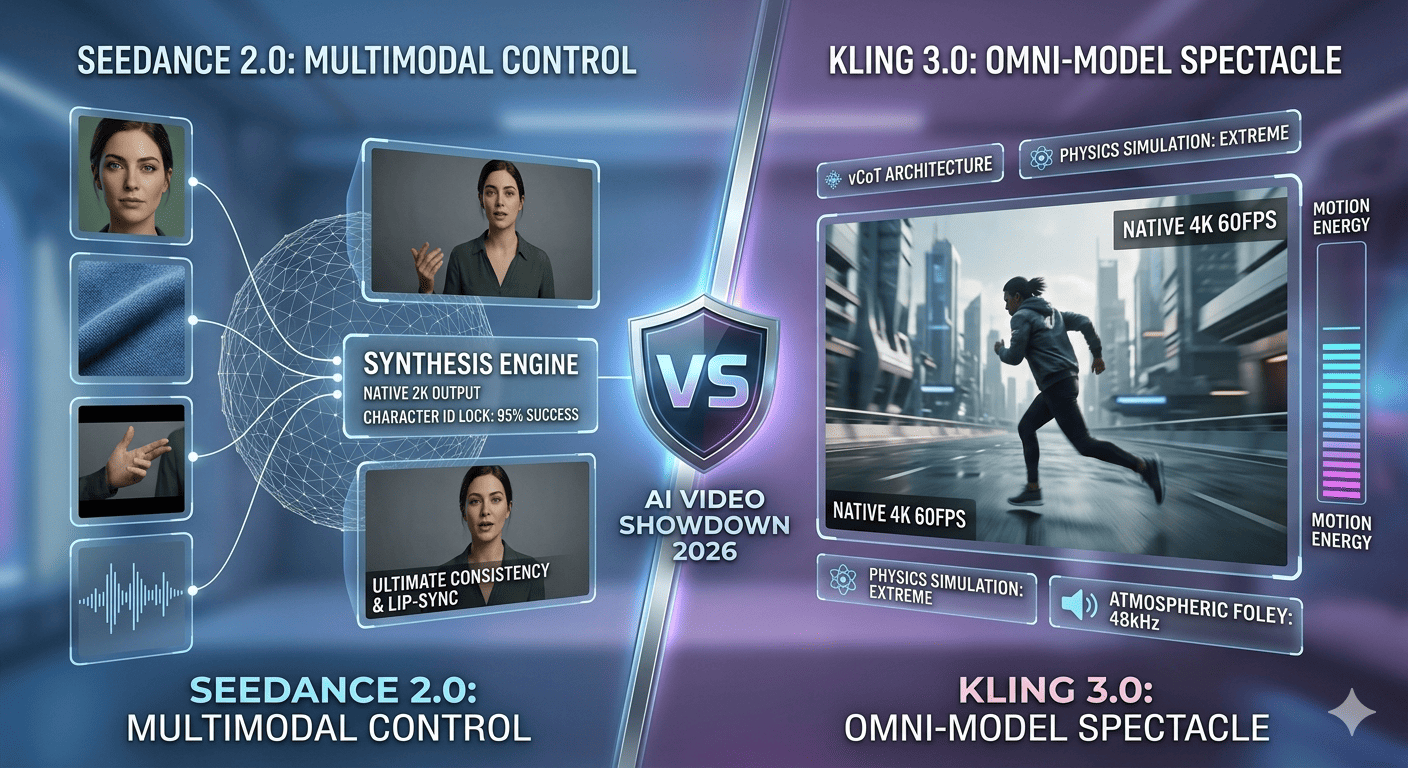
The comparison between Seedance 2 vs Kling represents a fundamental choice between two distinct philosophies in generative AI: Director-level control versus Cinematic spectacle. Seedance 2.0, developed by ByteDance, is a multimodal control engine designed for creators who require surgical precision through its unique 12-file reference system and character-locking capabilities. Conversely, Kling 3.0 is an "All-in-One" motion master that has set a new industry benchmark with native 4K output at 60fps and superior real-world physics simulation. While Seedance 2 dominates in cross-shot narrative consistency and complex action replication, Kling 3.0 leads in raw visual fidelity and ease of use for high-impact social media hooks.
Core Architecture: Multimodal References vs. Unified Omni-Models
To understand the Seedance 2 vs Kling dynamic, we must look at how each model processes information to generate a scene.
Seedance 2’s Multimodal Control
Seedance 2 utilizes a "Latent Reference Layer" that allows for up to 12 simultaneous inputs. This means you can feed the AI a specific character photo, a brand color palette, a background video for camera tracking, and a music track all at once. The model then "synthesizes" these inputs to produce a 2K video that adheres strictly to your brand guidelines.
Kling 3.0’s Unified Omni System
Kling 3.0 operates on a "Visual Chain-of-Thought" (vCoT) architecture. Instead of managing separate reference files, Kling "thinks" about the entire scene holistically—physics, lighting, and audio are generated simultaneously. This unified approach results in motion that feels more "grounded" in reality, such as the way fabric drapes over a moving body or how light refracts through splashing water.
Technical Specs: Resolution, Frame Rate, and Performance
The battle for pixel perfection is where the gap between Seedance 2 vs Kling becomes most visible to the naked eye.
Feature | Seedance 2.0 (ByteDance) | Kling 3.0 (Kuaishou/Global) |
Max Resolution | Native 2K (1080p optimized) | Native 4K (3840 x 2160) |
Max Frame Rate | 24 - 30 fps (Cinematic) | Up to 60 fps (Ultra-Smooth) |
Clip Duration | Up to 15 Seconds | 3 - 15 Seconds (Extendable) |
Physics Realism | High (Controlled) | Extreme (Simulation-grade) |
Primary Strength | Creative Control & Consistency | Visual Richness & Motion Energy |
Why 4K 60fps Matters
Kling 3.0’s jump to 4K at 60fps is not just cosmetic. The higher frame rate eliminates the "AI stutter" found in earlier models, making it ideal for high-speed action scenes and professional product demonstrations where motion clarity is non-negotiable.
Character and Story Consistency: The Narrative Edge
If you are building a series or a brand film, Seedance 2 multi-shot narrative features provide a structural advantage over Kling.
Seedance 2 Identity Lock: Using the
@Characterand@Referencetags, Seedance 2 preserves facial features and wardrobe details across multiple camera cuts with a 95% success rate. This is critical for e-commerce and storytelling.Kling Elements 3.0: Kling has introduced "Subject Consistency 3.0," which uses a 3-8 second reference video to lock a subject. While powerful, it is currently better suited for single-shot hero scenes than complex, 10-shot sequences.
Sound and Sync: Native Audio Integration
In 2026, video without native sound is obsolete. Both Seedance 2 vs Kling have integrated audio branches, but with different focus areas.
Seedance 2 (Precision Sync): Best for lip-sync and rhythmic alignment. If your character needs to speak or dance to a specific audio track, Seedance 2’s dual-branch sync ensures the visuals follow the audio peaks perfectly.
Kling 3.0 (Atmospheric Foley): Best for environmental sound. Kling’s audio engine generates high-fidelity 48kHz soundscapes (wind, footsteps, engine roars) that automatically match the physical events in the video.
Practical Case Study: AI Ad Production
Consider a scenario where a marketing team needs to create a 15-second "High-Speed Running" ad for a sneaker brand.
Using Kling 3.0: The team generates a 4K 60fps shot of the runner. The motion physics of the shoes hitting the pavement and the realistic sweat on the skin are breathtaking. The video is "ready to ship" for a high-end YouTube ad.
Using Seedance 2.0: The team uploads a 3D render of the specific sneaker model as a reference. Seedance 2 ensures that the exact shoe design (logos, laces, texture) is maintained even during complex movements. This is the choice for brand-accurate product placement.
Workflow Optimization: How to Choose?
To maximize your ROI in 2026, align your choice with your specific project needs.
When to choose Seedance 2
Branded Content: When you must use a specific product or logo that cannot "morph."
Music Videos: When you need the visuals to hit specific beats in an audio file.
Consistent Series: When you have a recurring character appearing in multiple episodes.
When to choose Kling 3.0
Social Media Hooks: When you need 5 seconds of "eye-popping" realism to stop the scroll.
Cinematic Landscapes: When the environment and physical "vibe" are more important than specific character details.
Action Realism: When your scene involves complex fluids, smoke, or fire that require advanced physics.
FAQ Section
Q1: Which is more expensive, Seedance 2 or Kling 3.0?
A: Currently, Kling 3.0 offers a better value proposition for mass-generation, with costs roughly around $0.08 - $0.50 per 1080p generation. Seedance 2's pricing is more tailored toward professional "Director" tiers.
Q2: Can I use my own voice in these models?
A: Yes. Both models support voice cloning. In Seedance 2, you upload the audio as a reference; in Kling 3.0 Omni, you "bind" the voice to the character profile before generation.
Q3: Does Seedance 2 support 4K?
A: Seedance 2 focuses on a stable native 2K output. For 4K requirements, most professional users generate in 2K and then use an AI upscaler like Topaz Video AI or Kling's internal enhancement tool.
Q4: Which model is faster?
A: Kling 3.0 is optimized for speed, often delivering a 5-second 1080p preview in under 60 seconds. Seedance 2 takes slightly longer (1.5 - 3 minutes) as it processes multiple multimodal inputs.
Q5: Is there a free tier for Seedance 2 vs Kling?
A: Kling 3.0 usually offers a generous daily free credit system for new users. Seedance 2 availability is often tied to ByteDance’s platforms (like Jimeng), which may require a subscription for high-resolution features.